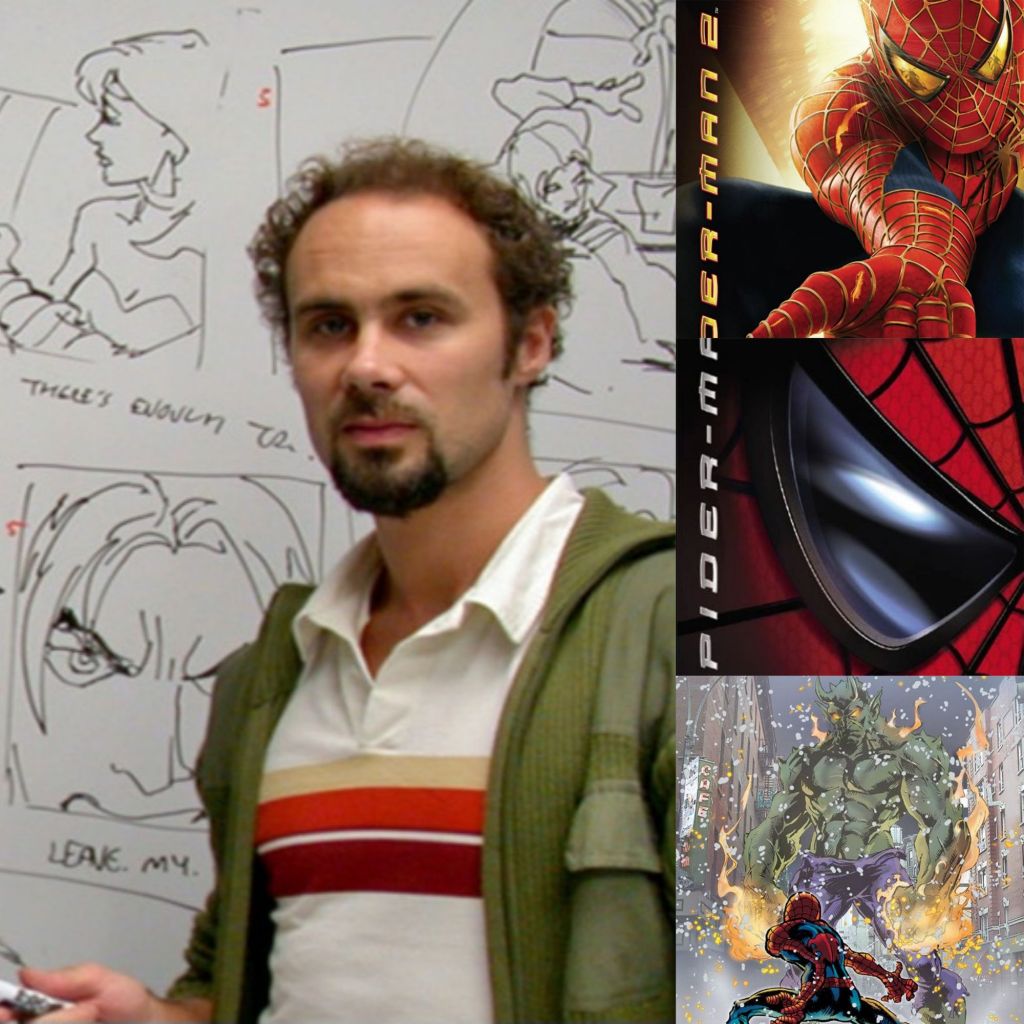
Before we start, I would like to thank Ian Hosfeld for giving me the opportunity to interview him about his work on the scrapped Ultimate Spider-Man 2 game, the Ultimate Spider-Man game, the Spider-Man movie games and more.
Ian will be revealing more about the scrapped Ultimate Spider-Man 2 game on his Instagram (@ianhosfeld), so make sure you are following him for that and to see more of his amazing work.
Now on to the interview, enjoy.
How did you first get into the gaming industry?
I’m originally from Norway. I studied fine art at SAIC in Chicago, but saw that working in entertainment illustration could be a viable career choice for a while. The right place for that was Los Angeles, so my wife and I got our belongings into Toyota Corolla and drove west till we hit the Pacific Ocean. It was the year 2000, a new decade, the Dot Com bubble had burst and nobody was hiring. I was doing freelance storyboarding around town when one day I had the good fortune of meeting Alex Bortoluzzi, one of my neightbours. He was working at a small game company called Treyarch and they needed to ramp up staffing for a big project they had landed. That project turned out to be Spider-Man The Movie Game.
My portfolio got me hired but they already had a concept artist on board. Would I be willing to start out doing environment textures? I had never worked with textures before, and I wasn’t enthusiastic about it. However, I knew how to paint, so I figured I could manage. Once part of the crew, I knew my talents would eventually be needed. Sure enough, I got to do some concepts and storyboards toward the end of production, and when the game was a big success and PreProduction of Spider-Man 2 started up, I was in a position to do character concepts, which iI consider to be my strength.
What was it like meeting Sam Raimi during the making of the Spider-Man 2 movie game?
Spider-Man 2 was surrounded in secrecy, as internet leaks were now a big thing, and Sony Studio had everything under wraps. It was difficult for Treyarch to start work on a project that we knew so little about, and the studio didn’t trust us with much in the beginning, as any of us could be a plauable leaker. In what later became a historic decision, our designers, pincipally Jamie Fristrom, crafted a physical swinging locomotion system within our proprietary engine. Since we didn’t have details on the story yet, focus then became how to make this game a revolutionary Super-Hero game, in which you truly became Spider-Man, and the game mechanics and enemy action would revolve around this new locomotion aspect.
Finally a small group of us got called in to Sony Studios to read the script, see the designs for Doc Ock, and meet with Raimi and ask him questions. I got to be part of this small group because we were not allowed to bring cameras, but I could recreate in sketches what I had seen. A human camera of sorts 🙂 I absorbed as much as I could and later relayed it to the team in drawings.
One thing I learned living in LA was that people we think of as famous, actors, directors, etc., are for the most part more down-to-earth than you’d think. Raimi was serious, professional, and what stood out most was how much he loved the source material, wanted to do it justice, and wanted us to do the same.
Were there any big challenges you faced while making concepts and storyboards for the Spider-Man games you worked on, and how did you face them?
The biggest hurdle was at the beginning, when we had no idea which direction Raimi would take with Otto Octavius/Doc Ock. In the end, he is a guy with four metal arms, and we knew that was unlikely to change, so it’s important not to get hung up on details. Eventually, we got the designs and Alfred Molina pics. The next challenge was to bridge the gap between the comics and the “Raimiverse”. My biggest achievement here, I think, was going outside the box for Mysterio, giving him a new twist that stuck in people’s minds.
With all the projects that you’ve worked on, it’s a given that sometimes things get scrapped. Does it ever disappoint you when some of your own work is omitted from the final project, and have you had any disagreements with omissions regarding your work?
Unfortunately, many of my character designs for SM2 were scrapped due to the enormity of the task and the impossibility of finishing it all on time for the movie’s launch. That’s the thing with these tie-ins: that game HAS to be on the shelves on that date, no excuses or extensions.
Besides the Mysterio, Shocker, and Black Cat missions, an important chunk of the game was a sprawling saga involving The Lizard, Kraven, and Calypso that adapted the “Torment” storyline from the comics. This, along with various Lizard Minions and miles of sewer tunnels underneath our Manhattan got cut, although eventually resurrected for the Spider-Man 3 game. In these cases, you have to put your ego aside and understand that decisions leading to “wasted work” are almost unavoidable in game development and are (mostly) never taken lightly. At least they live on in my portfolio.
How does it feel to still see people still play and talk about something you and others worked on from 20-ish years ago?
Frankly, it’s astonishing. In the period after Treyarch, where I did comics and went back to fine art painting, I lost sight of the world of Spider-Man and those games. It was in the past. Recently, I decided to give some attention to an instagram account I had created some years ago for my illustration, and then neglected. As soon as I started posting concepts from Spider-Man 2, people started responding enthusiastically. People from many countries told me how much they had enjoyed the games I had worked on, sharing happy memories and how, in some cases, the work had inspired them. It was eye opening.
Now I’m happy to provide these long-lost glimpses of the creative process behind the games, although I’m a bit worried about audience capture. The response I get from Spider-Man related content far outweighs any of my other illustrations. For the time being I will continue to post from the Spidey archives, but I hope fans will also come to appreciate my other work.
Would you like to see a remake/remaster of Ultimate Spider-Man/Spider-Man 1 & 2, and do you think it will ever happen?
A remaster would be amazing. A big frustration when working on these games are the limits put on your creation by dev time constraints and processing power. A remake, I have to say that the recent insominac games are true heirs of our Spider-Man 2, but Given the size of the fan base,a remaster of the old games makes a lot of sense, maybe putting back some of the cut content.
As some may know, Ultimate Spider-Man 2 was in development at some point. How deep in development was Ultimate Spider-Man 2 before it was scrapped?
We didn’t get too far, it was mainly Brian Reed, the writer, Chris Busse, the Lead Designer; and Chris Soares, the Art Director, and I, laying out the main story points along a thread that Bendis had suggested, involving the Osborns and their Goblin alter egos. The fire-wielding Green Goblin would be the other playable character, like Venom was. We explored that part, as well as guest stars like Wolverine and Daredevil. I have a bunch of story point drawings that recently got leaked from somewhere, so now that the cat’s out of the bag I’ll be posting those to give people an idea of what could have been.
Why was Ultimate Spider-Man 2 scrapped, and is there anything else you’re allowed or want to say about the game?
Ultimately. if you’ll allow the pun, it came down to sales numbers. USM performed adequately, but Activision’s expectations were so high given the incredible numbers of the two first movie games, that the result was disappointing in comparison. Turns out the audience for the movie was way bigger than a comic-specific take. USM2 was cancelled, and for a while we explored a multiplayer Marvel Universe game, along the lines of the original Secret Wars. That didn’t get very far because Activision, who had bought Treyarch by then, acquired the James Bond franchise, and our team was assigned to develop that game. I left soon after, wanting to pursue my own projects, specifically The Circle, a creator-owned spy comic that Brian Reed and I published at Image Comics in 2008. You can still find the issues on eBay. Lately, I’ve been developing concepts for tabletop games, including Blood and Plunder (a pirate-themed game), War Stories (a WW2 game), and recently, Brigands of Årja (a sword-and-sorcery-themed game).
You can see more of Ian’s work at his site, http://www.ianhosfeld.com
And his Instagram @ianhosfeld
 Spider-Man News